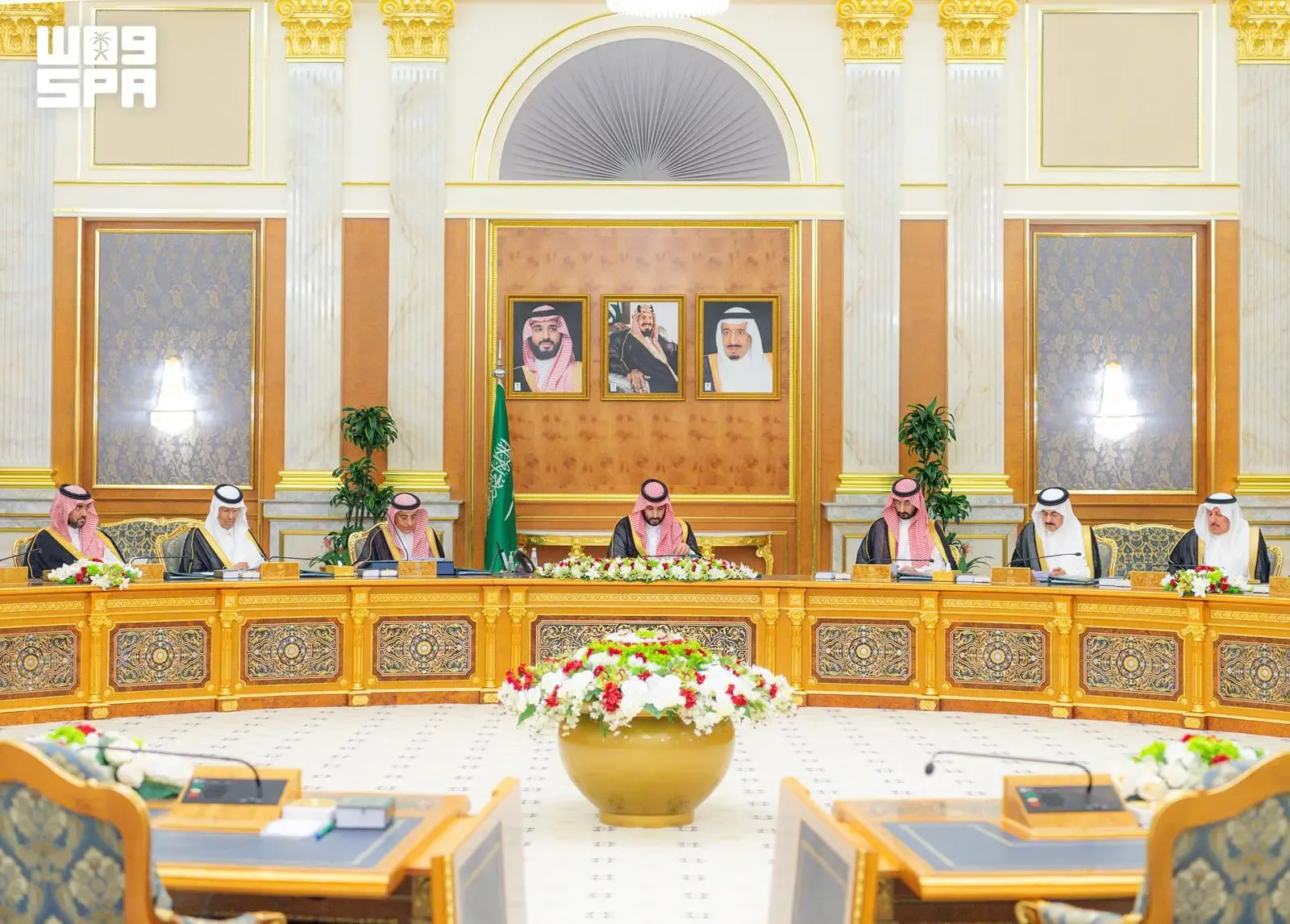
Chaired by the Crown Prince: Cabinet Condemns Iranian Militia Attacks and Affirms Saudi Resolve to Defend Its Security
Crown Prince Mohammed bin Salman chaired a Cabinet session in Jeddah, condemning Iranian-backed militia attacks and affirming Saudi Arabia's commitment to security.
His Royal Highness Prince Mohammed bin Salman bin Abdulaziz Al Saud, Crown Prince and Prime Minister, chaired the Cabinet session held today in Jeddah.
At the beginning of the session, the Crown Prince briefed the Cabinet on the contents of his phone calls with His Highness Sheikh Mishal Al-Ahmad Al-Jaber Al-Sabah, Emir of the State of Kuwait, Prime Minister of the Islamic Republic of Pakistan Muhammad Shehbaz Sharif, and Prime Minister of the United Kingdom of Great Britain and Northern Ireland Andy Burnham. The discussions reviewed the latest regional developments and efforts to enhance regional security and stability.
The Cabinet strongly condemned the attacks by Iranian-backed terrorist militias in Yemen and Iraq on oil facilities in the Riyadh and Eastern regions, and on commercial ships in the Red Sea. The Cabinet emphasized that the Kingdom of Saudi Arabia will not hesitate to protect its security and national interests and will respond firmly to any hostile acts in accordance with international humanitarian law and customary rules, in line with the principle of proportionality.
The Cabinet stressed the necessity for the Iraqi government to take all necessary measures to prevent its territory from being used as a launchpad for aggression, appreciating the positions of world countries and international organizations condemning the criminal attacks, which were efficiently countered by Saudi air defenses.
Acting Minister of Education and Minister of Media, Mr. Yousef bin Abdullah Al-Bunyan, stated to the Saudi Press Agency after the session that the Cabinet followed the ongoing efforts by Saudi Arabia in communication and consultation with brotherly and friendly countries to de-escalate tensions in the region, ensure the security of waterways in the Arabian Gulf and the Red Sea, and support all that contributes to achieving regional and international stability.
The Cabinet affirmed Saudi Arabia's commitment to fostering dialogue and diplomacy and enhancing international cooperation, especially given the critical phase the region is experiencing, which requires establishing a regional system based on adherence to the fundamental principles enshrined in the United Nations Charter, foremost among them the preservation of state sovereignty, non-interference in internal affairs, respect for good neighborliness principles, ensuring freedom of navigation, and compliance with international law.
On the domestic front, the Cabinet discussed the state's overall activities, particularly in continuing to improve the performance of its sectors and agencies and enhancing services provided to citizens, while continuing to issue regulations and decisions aligned with the desired aspirations. This includes the issuance of the new public education system, which will, God willing, mark a significant step in the development and governance of this sector, providing the necessary enablers to achieve its targets, and enabling it to enhance the quality of the educational environment and its outputs, and organizing the roles of the private and non-profit sectors in a way that achieves the goals of Saudi Vision 2030.
His Excellency noted that the Cabinet commended the Quality of Life Program for achieving results that exceeded the economic and developmental targets set for its strategic initiatives, continuing its growing role in contributing to the non-oil GDP, developing services in all cities, and advancing the culture, sports, entertainment, and tourism sectors to new horizons that have enhanced the Kingdom's position as a globally attractive destination.
The Cabinet noted that the Kingdom ranked first regionally for the fourth consecutive year in the "Maturity of Electronic and Mobile Government Services" index issued by the United Nations Economic and Social Commission for Western Asia (ESCWA), which is an extension of the achievements made in related international indices, reflecting the continuous progress in developing procedures and platforms, adopting emerging technologies and artificial intelligence, and establishing a global model in business practices and digital economy competitiveness.
The Cabinet reviewed the topics on its agenda, including those shared with the Shura Council, and reviewed the conclusions of the Political and Security Affairs Council, the Economic and Development Affairs Council, the General Committee of the Cabinet, and the Cabinet's Expert Committee on these matters, and concluded the following:
First:
Approval of an agreement between the Government of the Kingdom of Saudi Arabia and the Government of the Arab Republic of Egypt regarding the mutual exemption from short-stay visa requirements for holders of diplomatic and special passports.
Second:
Approval of a memorandum of understanding between the Government of the Kingdom of Saudi Arabia and the Government of the State of Kuwait in the fields of science, technology, and innovation.
Third:
Authorizing the Minister of Environment, Water, and Agriculture - or his designee - to discuss with the Syrian side regarding a draft memorandum of understanding between the Ministry of Environment, Water, and Agriculture of the Kingdom of Saudi Arabia and the Ministry of Agriculture and Agrarian Reform of the Syrian Arab Republic for cooperation in the field of agriculture, and to sign it.
Fourth:
Authorizing the Minister of Environment, Water, and Agriculture, Chairman of the Board of Directors of the National Center for Plant Pest and Animal Disease Prevention and Control - or his designee - to discuss with the Near East and North Africa Plant Protection Organization regarding a draft agreement between the center and the organization for cooperation in the field of plant health, and to sign it.
Fifth:
Approval of a memorandum of understanding for cooperation in the field of food security between the General Authority for Food Security in the Kingdom of Saudi Arabia and the Ministry of Municipality in the State of Qatar.
Sixth:
Approval of naming the year (2027) as the "Year of Water".
Seventh:
Transferring digital and operational services directly related to real estate documentation operations, which are an essential part of the integrated real estate system - including its technical infrastructure, operational teams, and data - to the General Authority for Real Estate, including: (Real Estate Exchange Platform, Exchange Mobile Application, Comprehensive System, Data Indexing System, Document Digitization System, and Basic Data Entry System), within (six) months.
Eighth:
Extending the requirement for (one) year that labor disputes must be preceded by an attempt at amicable settlement through the Labor Office before being brought to the Labor Court.
Ninth:
Approval of the final accounts of the Saudi Electricity Regulatory Authority, the General Authority for Food Security, the National Risk Council, the National Program for Community Development in Regions, the National Program for Information Technology Sector Development, and the universities of (Umm Al-Qura, and Imam Abdulrahman Bin Faisal) for two previous fiscal years.
Tenth:
Issuing necessary directives regarding several topics on the Cabinet's agenda, including annual reports for King Faisal University, Princess Nourah bint Abdulrahman University, and the Islamic University of Madinah.
Eleventh:
Approval of promoting Abdul Salam bin Nasser Abdul Salam to the position of (General Manager) at the (fifteenth) rank at the Ministry of Human Resources and Social Development.