The Journey of Hope from Suva to Riyadh: Conjoined Fijian Twins Sponsored by Saudi Arabia After Three Countries Requested a Million Dollars
Saudi Arabia has offered to separate conjoined Fijian twins for free, covering all costs, after several countries demanded a million dollars upfront.
Saudi Arabia has launched a humanitarian initiative to separate conjoined twins from Fiji, who were born joined from below the sternum to the pelvis, after several countries refused to accept the case or demanded a million US dollars upfront for the surgery. Riyadh has offered to perform the operation free of charge at King Salman Hospital, in addition to covering travel tickets and accommodation for the entire family, a move praised by the Fijian government as a testament to the 'amazing bilateral relations' between the two countries. The Saudi medical team is currently evaluating the twins' condition to determine the surgery date, amid high hopes for a successful separation despite the potential medical loss of one of them.
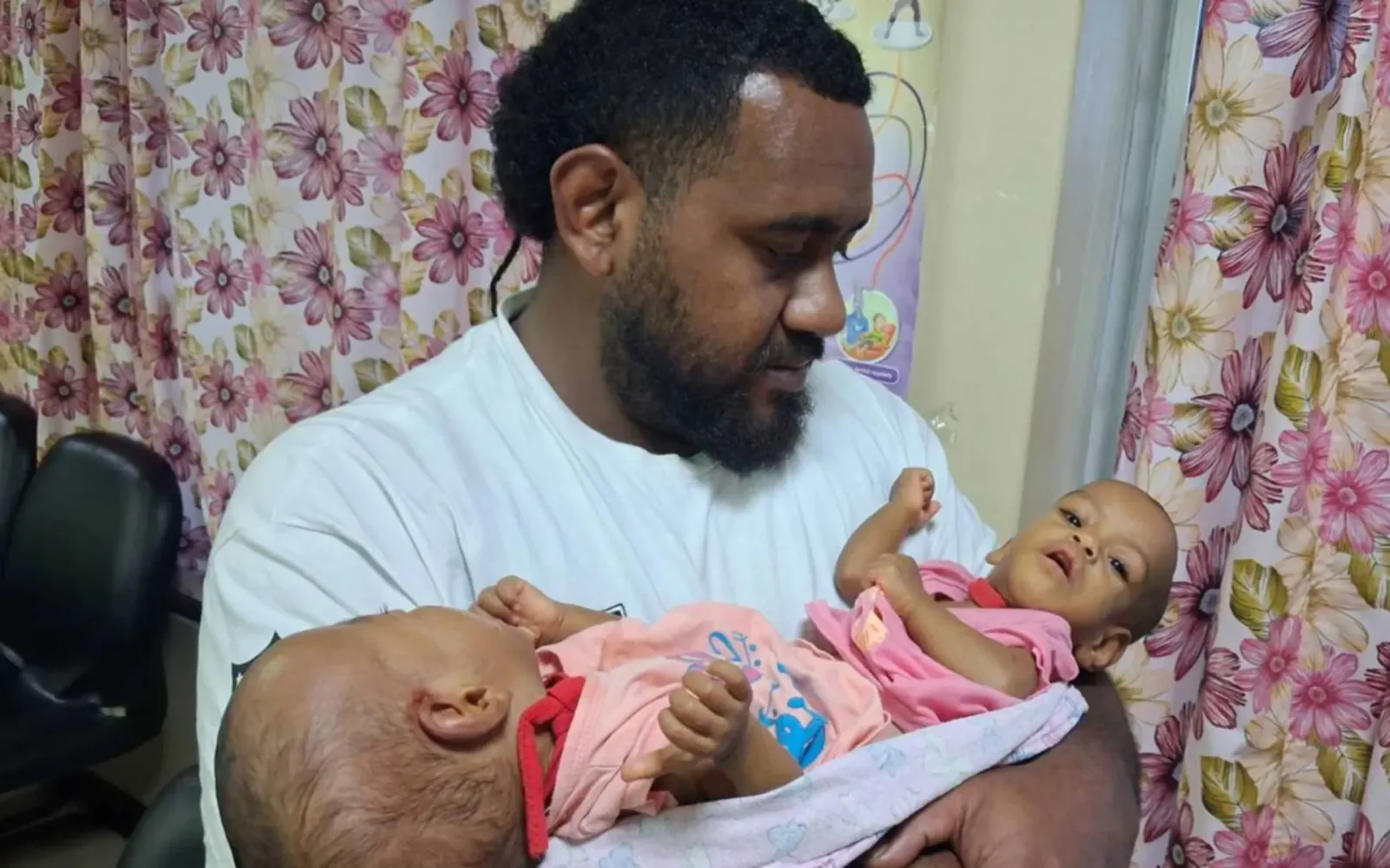
When Fijian mother Akinata Volemaigeladi gave birth to triplets two months prematurely at the Colonial War Memorial Hospital in Suva, doctors gave her only a few days to say goodbye to two of them. The twins, De Sicia and Jessibelle Kikau, were conjoined from below the sternum to the pelvis, marking the first case of conjoined twins in Fiji in twenty years, while their third sister, Hosanna, was born healthy beside them.
'The doctors said they might only live for a few days,' the mother recalls in a video published by the Fijian Ministry of Health. But the twins defied expectations; they spent two months in the neonatal care unit with their sister, then went home to the village of Rewa, starting another, more challenging journey: finding a country willing to separate them.
Eight Months of Rejections and 'One Million Dollars Upfront'
The pediatric team at Suva Hospital knocked on the world's doors one by one over eight months. Dr. Elisapeci Tuibeqa, a member of the treatment team, told New Zealand's 'RNZ Pacific' radio: 'We approached Mexico, the United Kingdom, and the United States, but they demanded a million US dollars upfront for the surgery.' Worse still, according to the doctor, several countries showed interest in the operation only for 'research purposes.'
Even neighboring countries let the family down. Fiji requested humanitarian support from Australia, citing Sydney Children's Hospital's approval of a similar operation for twins from Papua New Guinea, 'but we were told it wasn't possible.' They also asked New Zealand, but their doctors apologized due to the complexity of the surgery and the need for a multidisciplinary team.
During those months, the mother silently suffered: 'We were worried about the twins; I was affected when I watched them and saw other children. I would get emotional and cry, but I knew there was a living God who would ensure they lived.'
Then Came the Response from Riyadh
Amid this deadlock, the Saudi government offered to perform the surgery completely free for humanitarian reasons, as part of its humanitarian program for separating conjoined twins, also covering the entire family's travel tickets and accommodation throughout the treatment period. The Fijian government described the initiative as evidence of the 'amazing bilateral relations between the two countries,' and arranged for a pediatrician to accompany and coordinate with the Saudi team.
On Wednesday evening, the family departed from Nadi International Airport on a long journey through Hong Kong and Doha, arriving in Riyadh, where the twins are scheduled for a surgery estimated to cost millions of dollars — none of which the family will pay.
Two Bodies in One
Dr. Tuibeqa explains the condition in detail: the twins are conjoined from below the diaphragm to the pelvis, each having their own heart, lungs, and stomach, but sharing only two kidneys instead of four, two ureters, one bladder, parts of the intestines and colon, one anus, and one female reproductive system — 'but they have four legs.'
Despite all this, the twins have grown remarkably healthy; they have only been hospitalized once or twice, one of which was due to minor intestinal bleeding. 'They were growing and appeared equally healthy,' says the doctor, who described herself as 'exhausted but overwhelmed with joy' when the Saudi approval came through.
The Fijian team has shared X-rays and medical reports with Riyadh doctors since the twins were two to three months old, and King Salman Hospital will review the case again before setting a surgery date.
'We May Lose One and Save the Other, But We Hope'
The medical outlook is encouraging; conjoined twins below the chest 'generally have favorable separation outcomes,' says Tuibeqa: 'One can live with one kidney, reproductive organs can be reconstructed, intestines can be given to one, and a colostomy can be performed for the other.' However, she does not hide the truth she shared with the family: 'All possibilities are on the table; we may lose one and save the other, but we all hope for a successful separation.'
Hope here has a known price in the region's memory: just months ago, the Papuan twins Saong and Tom Kevin — born in a remote village in Morobe Province — underwent emergency separation surgery in Sydney, with only Saong surviving. Fiji itself bears an older wound: its first conjoined twins, born in 2004, shared a heart and liver, and died of cardiac complications before reaching a treatment flight to Melbourne.
This time, the plane precedes fate. De Sicia and Jessibelle are now in Riyadh, with a mother who repeats that they have a Saudi team with global expertise in separating twins — without asking anyone for a million dollars.
